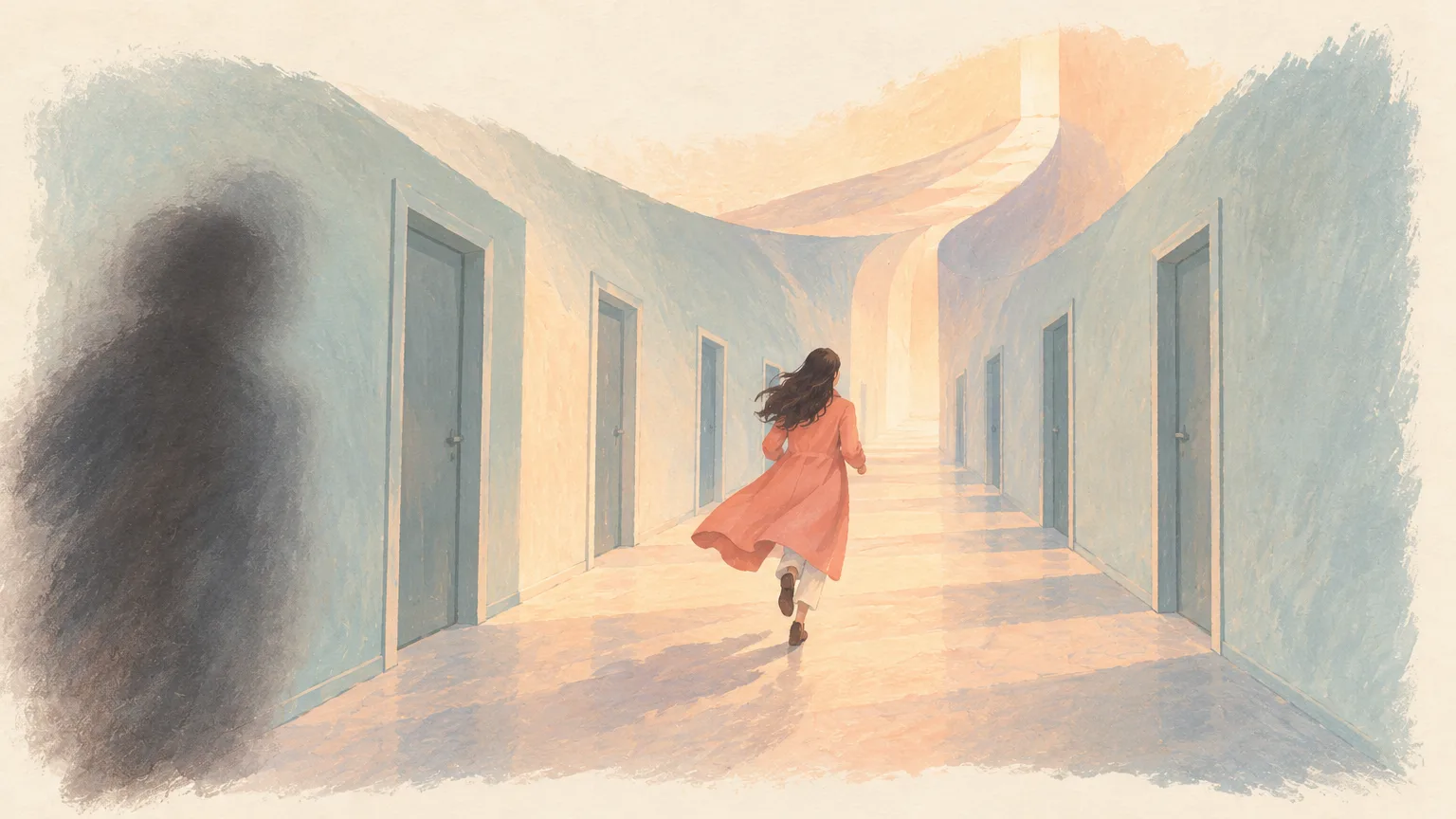
Recurring dreams: why the same dream comes back
Most adults have had a dream that keeps returning. What these dreams tend to hold, why they may come back, and four ways to look at your own.

You have been here before
The same house, with a room you had forgotten about. The same exam you have not studied for. The same train pulling away as you reach the platform. Sometimes you know where the dream is going before it gets there.
A recurring dream has a particular feeling. It is less like a story and more like a place you keep being returned to. And when you wake, the question is hard to shake: why this one, again?
A very common kind of dream
If you have a dream that keeps coming back, you are in large company. Researchers summarising several surveys report that somewhere between 60 and 75 percent of adults say they have had a recurring dream at some point in their lives.
Studies of adults' recurring dreams find that most are unpleasant, though not all are frightening. A sizeable share held no danger at all: a familiar place, an ordinary task, someone you know. Some of the themes people describe are wonderfully specific, like a house that is falling apart, or the discovery of new rooms you never knew were there.
When a recurring dream does carry a threat, it is usually aimed at the dreamer. In one study of more than two hundred recurring dreams, the dreamer rarely managed to escape, even after trying hard. Many of these dreams simply end with waking up.

Why the same dream returns
Many dream theories, from quite different traditions, agree on one idea: a recurring dream is often tied to something unresolved in the dreamer's life. Researchers have found that having recurring dreams as an adult tends to go together with stress and lower well-being.
There is a hopeful side to this. There is also evidence that when recurring dreams stay away for a long stretch, a person's sense of well-being tends to lift. That does not prove the dream caused anything. But it suggests the dream may rise and fall with what is happening in your days.
So a dream that keeps coming back is not necessarily a warning. It can be a sign that something still has your attention.
How to look at your recurring dream
Rather than asking what each object stands for, it can help to look at the pattern. Four anchors are a good place to start:
- what keeps happening
- what feeling arrives first
- what your role is inside the scene
- what changes from one version to the next
The first three show what stays the same. The fourth is often the most interesting. The house may be the same, but this time a door is open. The exam may come back, but this time you find the right room.
A recurring exam dream, for example, does not have to be about school. It can point to feeling judged by standards you did not choose, or to performing well while feeling unprepared. The setting can be borrowed; the feeling may be what keeps returning.
Try putting two versions side by side. What happened in the earlier dream, and what happened this time? Perhaps you spoke where you once stayed silent, or someone familiar was missing. Does that difference remind you of anything in your waking life?

When the dream starts to change
A recurring dream may not stay fixed. It might soften, grow stranger, or give you more room to act. If yours has shifted, you could ask what changed first: the place, the people, or the way you responded?
You might also look at when the dream appears. Does it return in busy weeks, after a certain kind of conversation, or around the same time of year? A pattern in your nights can sometimes match a pattern in your days.
If a recurring dream replays something that really happened to you, or comes back often as a nightmare, a doctor or sleep specialist can help. These nightmares often respond well to treatment.
Your returning dream
A dream that comes back has been carried with you for a while. That alone makes it worth a closer look, not with a fixed meaning in hand, but with curiosity about why it chose this shape.
What is the dream that keeps finding you, and what was different the last time it came?